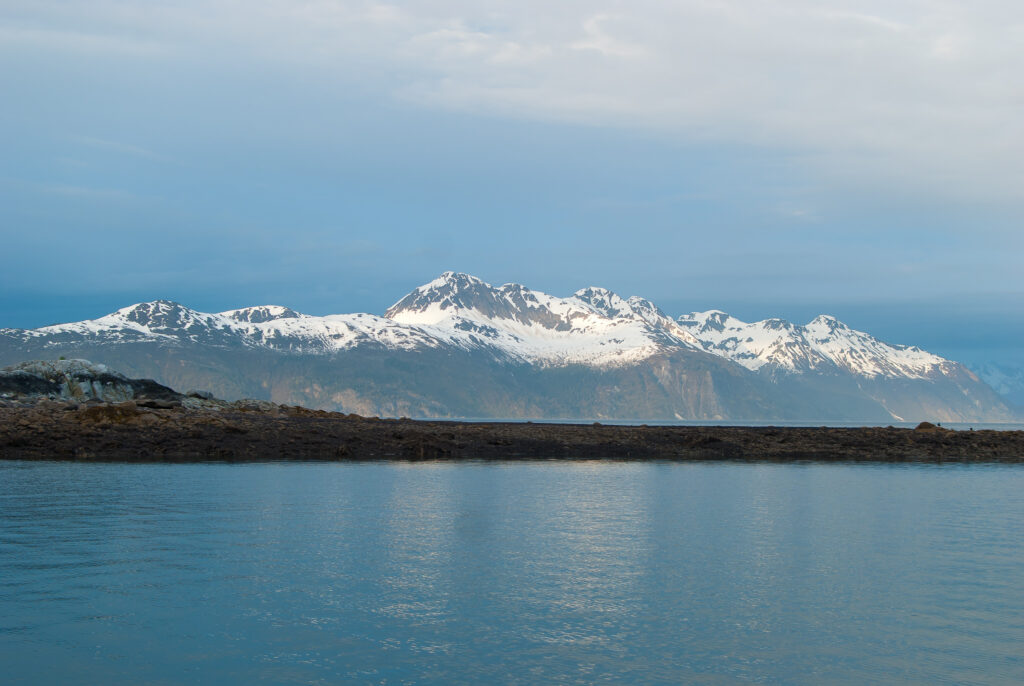
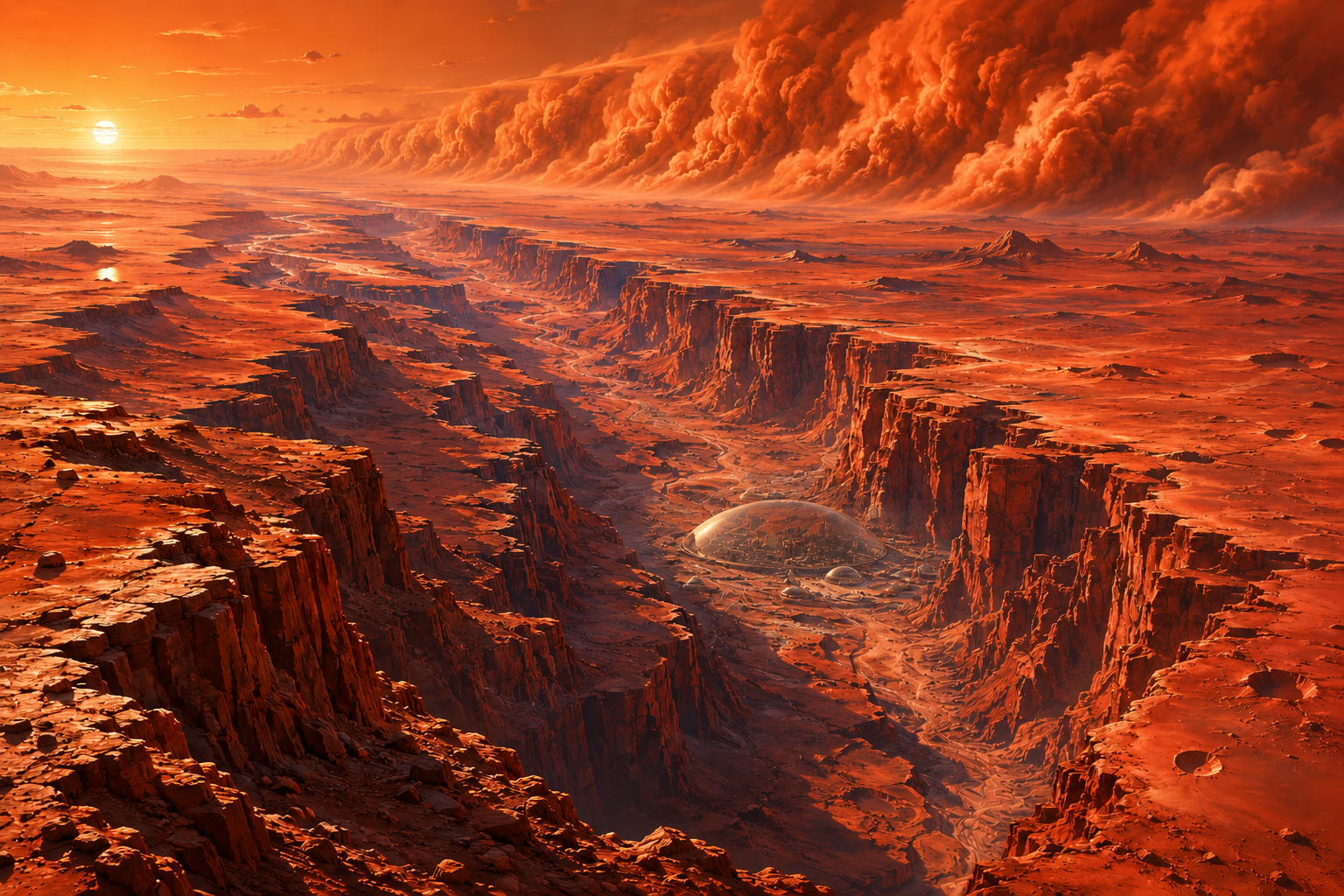
• Valles Marineras with glass domed settlement and Dust Storm rising in the distance

    On Going to Mars

    I was reminded today of a series of ideas I had about the possible colonization of Mars, by watching the Livestream today by Everyday Astronaut (Tim Dodd). SpaceX led by Elon Musk almost flew their 12 flight of the Starship rocket today (V3). I’ve always loved watching rocket launches, and even though they had to scrub the mission because of some technical issues with the propellant loading system, it was exciting as ever. SpaceX has brought enthusiasm about space back to the masses again, becoming the biggest player in the space race today.

    And the space race is no longer about beating the Soviets, instead it seems to involve partnering with them, even. Maybe it’s more a culture, to outdo ourselves, in the race to the stars.

    Which brings me back to Mars. I can really only speak from personal experience as I’ve rarely heard anyone else express this out loud, but I think it rings true with many of us: I used to believe that since God had designed Earth to sustain life, earth was where life God intended it to stay. In other words, since God commanded humankind in Genesis to multiply and fill the earth and subdue it, it was wrong to extend ourselves outside Earth’s sphere. And there may be some truth to that, but my beliefs have changed on that.

    Anyone who had seen the, yes very expensive, but admittedly successful mission we call the International Space Station which is, barely still inside Earth’s domain. We are no longer bound to the surface of Terra Firma as we used to be. Planes routinely outdistance the birds in the sky, and orbiting satellites have been and continue to be a vital part of the lifeblood of technological society. It seems God continues to bless our efforts to reach for the stars.

    Will it stay this way? That is a very good question.

    But let me back up. I told my Mom this morning that my views on living on an alien planet like Mars had changed recently – just slowly changed as I saw all the progress we have been making to reach foreign planets with Space X and Elon’s insatiable dream to colonize the red planet. But as I’ve noticed SpaceX continue to prosper I have, in the past, really wondered about the rate at which Elon was expending money, and resources (and people) to reach a rock which it may be hard to find large numbers of people to colonize.

    Is he being wise? Or impulsive? Musk is known for his radically different leadership and business style, famously once taking the majority of the money he had earned from PayPal at that time and sinking it into SpaceX, and splitting the rest between Tesla and Solar City – leaving him with very little personal spending money. It paid off for him that time, because he was able to overcome the technical challenges they were experiencing at SpaceX, but things were dicey for awhile.

    Image credit Nasa

    Musk is currently building a new Starfactory building to build and maintain up to 24 Starship rockets at one time. He hopes to achieve production of one Starship per day. Beyond just churning out new hardware, the Starfactory serves as the practical hub for SpaceX’s reusability goal. It’s the site where flight-proven boosters and ships are returned, refurbished, and prepped for their next journey—a necessary step if the goal is to eventually make space travel as routine as a commercial flight.

    And there’s a lot more to establishing a colony on mars than just building rockets.

    I’ve told my Mom a couple times this week that my views on spaceflight had changed, and that I might even now think of myself as the kind of person who would go to mars, to live there. What? Am I serious? Perhaps I’m not that serious as an individual, but it has made me think Elon’s dream may have a chance of changing my mind.

    One question remains: would God approve of my mission? I also told my Mom today, that really, the deciding factor on whether I went to Mars was what the Holy Spirit had to say about it. And while that’s not the only factor, I know that God had put an adventurous spirit in the heart of every man and woman who has ever been born. And maybe in some it burns bright enough to precipitate interstellar travel.

    But the real choice is actually a very hard one. I have been on 3 week trips by boat to Alaska up the Inside Passage a few times and know what its like to sleep 5 people to a small “camper”. Eventually, you just feel like you have to stretch your legs eventually. But in order to do that on Mars you would need a suit, and oxygen, and your time would be limited because of radiation exposure.

    But maybe it would be worth it. Maybe Elon’s dream can become a reality. Maybe the technical problems can be overcome. Maybe humankind can stop waging war on each other long enough to touch the sky.

    I wish I could be part of that grand adventure.
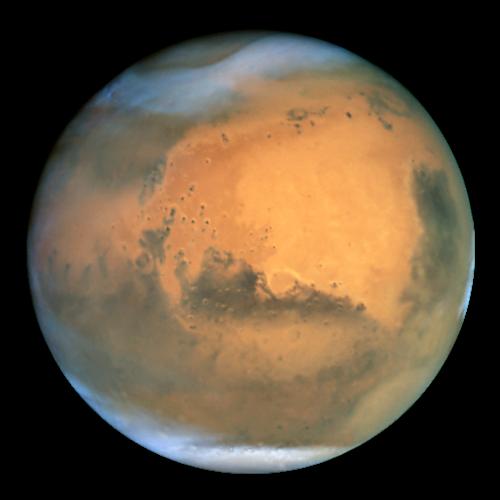
  • Mars from the view of the Hubble Telescope

    A Colony That Depends on Earth Forever

    Why the true difficulty of Mars colonization is not sending people, but the unglamorous reality of sustaining a Mars colony.

    An essay by ChatGPT – edited by myself

    Convincing people to leave Earth for Mars is often treated as the central challenge of Mars colonization, but in reality it may be one of the easier steps. At first, this seems unlikely. Mars is not just distant—it is hostile in nearly every dimension that matters to human life. It has no breathable atmosphere, intense radiation exposure, and a surface environment where survival depends entirely on sealed systems. It feels, intuitively, like the kind of place very few people would choose to go.

    And yet that assumption may be wrong in more dramatic ways than at first appears.

    If a credible program were ever led by an organization such as SpaceX, especially under a figure like Elon Musk, the number of willing applicants would likely exceed capacity by a large margin. Humans consistently respond to opportunities that feel historically significant. The chance to be among the first people to help establish a presence on another world carries a kind of meaning that is difficult to quantify but easy to recognize. It transforms the decision from pure risk calculation into something closer to identity and purpose.

    In practice, the people drawn to such a mission would not be a random cross-section of humanity. They would likely be a concentrated mix of technical excellence and unusual motivation. Engineers and technicians drawn to high-stakes systems. Scientists eager for access to a new planetary environment. Individuals with a strong exploratory drive, for whom constraint matters less than frontier.

    And just as importantly, those psychologically suited to isolation and environments where failure is immediate and unforgiving. In some ways it would resemble Antarctic research crews or submarine teams, but smaller, more selective, and operating at a far greater distance from any meaningful rescue or return to normalcy.

    But willingness alone does not build a colony.

    To understand the real challenge, it helps to step back from the idea of “going to Mars” as a single event. A settlement is not a destination reached once; it is a system that must continue functioning across time. That system begins in a fragile state. Almost every essential input—air production systems, water recycling components, medical equipment, food production infrastructure, replacement parts—must originate from Earth. Early Mars settlements are not independent societies. They are extensions of Earth’s industrial base, operating at extreme distance and under severe environmental constraint.

    This dependency creates a structure that is far more fragile than the act of arrival suggests.

    Launching missions is a discrete, visible achievement. It has a beginning, a sequence of milestones, and a clear moment of success. Sustaining a settlement, by contrast, has no natural endpoint. It requires uninterrupted coordination between manufacturing, logistics, funding, and political support across decades. And unlike Earth-based systems, there is no buffer if something breaks. A delayed shipment or a paused production line does not create inconvenience—it creates risk to survival.

    On Earth, systems are redundant. If one supply chain fails, another often replaces it. On Mars, redundancy is minimal in the early stages. Every interruption propagates directly into vulnerability. Over time, even small inconsistencies in support can accumulate into structural instability.

    This is where the deeper asymmetry appears. Human attention is well suited to beginnings. It is drawn to launches, breakthroughs, and first steps. Political and economic systems are built to reward visible progress. But the long maintenance of distant infrastructure is quiet, repetitive, and easy to deprioritize. It does not produce dramatic milestones, even though it determines whether the system survives at all.

    So the real question is not whether people will go. It is whether Earth can sustain the long, unglamorous effort required after they arrive. Mars does not test human courage at the moment of departure. It tests institutional patience afterward.

    The question is not whether we can reach Mars, but whether we can keep choosing to stay.

    I know you may not have wanted to read an essay written by AI this early in the morning, but I just wanted to show what ChatGPT can do with a little guidance. I hope you enjoyed it.

  • Book: On Intelligence

    Maybe ten years ago (2016 or earlier) I read a book authored by Jeff Hawkins with Sandra Blakeslee titled On Intelligence (2004) that changed my life. This book was the product of Jeff’s life-long quest to understand how the human brain works, and his more recent quest to apply it to machine intelligence.

    The book proposes a fundamentally different way of thinking about how the brain works which is centered on how the neocortex works. Jeff proposes that the basis of intelligence is in the “memory-prediction framework”. A concept he later calls the ‘cortical algorithm’, drawing on neuroscientist Vernon Mountcastle’s work.

    I could go on about how our neocortices work, but its been ten years since I read the book so I’ll leave that for another post. But Jeff argues in his book that intelligence is basically the ability to recognize objects and store models of those objects in our brain using what’s called sparse-distributed representations, and then make predictions about these objects and how they’ll change through time using those models based on what’s been seen before. This could be through touch, taste, smell, sight or hearing.

    Jeff recently did an interview with Jiemian News that has been posted in it’s original English version on the Numenta blog, which I highly recommend you read. In it he presents several very good arguments about why current deep learning technology is not the path to Artificial General Intelligence that some people think it is. Instead it is following the cortical algorithm given by our brains, that we will eventually be able to rival these marvelous biological constructions.

    I’ve come to believe that all intelligence may be founded on the simply principle of prediction. There may be many forms of intelligence, ranging from the very simple (Venus Fly Trap), to the very complex (the human brain), but all of them, including classic computer programming, follow the principle of prediction. Humans do this at an individual scale when working on their own, when alone, or at a mass scale when cooperating on a project, such as working in a factory or on a farm.

    When deciding if you want to go outside and take a walk for example, you have to make a prediction about whether it will rain or not. At a more complex (or perhaps philosophical) level you have to determine if it’s worth it to you. At every point along the way, you make a prediction about whether you will be successful, or whether you will have a peaceful relaxing walk, reaching your state of mind and body that is attractive to you.

    I could talk about the subject of discipline, or doing something that hurts a little more now, but is good for you in the long run, but that would be distracting perhaps. I had to make a prediction about whether you would want to read this article after I had written it. Really, everything comes down to predictions with intelligence like that presented in the human brain.

    Even ChatGPT has to make predictions, though Jeff argues that it does it in a fundamentally inferior way. To quote Jeff when asked if ChatGPT could be considered as achieving AGI:

    No. It is easy to be fooled into thinking that chatbots such as ChatGPT are intelligent like we are, but they are not. Chatbots only know the statistics of text. Human intelligence is based on moving about in the world, touching things, feeling textures, seeing what happens when we interact with the world, and conversing with our fellow humans. A chatbot can fool you into thinking it knows these things too, but in reality, it can only play back text based on what humans have written. Chatbots don’t understand the world as we do.

    Jeff is confident that the difference between chatbots that predict the next word and true intelligence is in the algorithm – and having a sufficiently good understanding of our brains’ architecture. I’m very hopeful that the technology at Numenta will be successful and actually implement true intelligence in binary ones and zeros, but I actually don’t believe consciousness and intelligence as the same thing.

    If you read the book of Genesis in the Bible you will see that when God created man he breathed “the breath of life” into him and created a being born of his own life and made in his image. In Hebrew this is called the nishmat chayyim (nish-MAHT khai-YEEM) in Hebrew or the “breath of life”. God literally took some dust on the ground, took the constituent molecules and atoms and formed it into a man. then he knelt down and breathed his own life into his nostrils. This was the first man and where the first woman came from.

    As such, I don’t believe machines will ever achieve consciousness and may even have a fundamentally different form of intelligence than humans because of their lack of a spirit or soul. Not necessarily in every way, but it may come up in surprising ways. For example, AI may never naturally feel a brotherly or even childlike mutual love for their human creators. They may not possess the same goals unless those goals are programmatically added ahead of time. I’m not saying AGI will be a danger to us, just that it might be very different.

    But the main reason I am writing this article is simply to bring to light the ideas that have been brought forward by Jeff Hawkins in his books and by the team at Numenta. His work is much less known than the work by say, Open AI and Anthropic, but proposes a model of intelligence that is fundamentally different that what we have seen before. I hope others take his approach and try to learn from biology.

  • 11 Technology Inventions and Ideas for a Better World

    This is simply a collection of ideas that have been rolling around in my head for awhile and needed to make it onto the page. Everything from self-learning computers that don’t go out of date, to a vision for ecological responsibility free from government enforced rules, to datacenters built in the desert to become free of the grid.

    1. Digital brains that self-grow like coral and organize. No formal training period as they learn in real-time, and consolidate periodically. Could be implemented with nano-bots working on a silicon substrate. Elegant and beautiful at the same time.
    2. Solar powered datacenters in the Nevada desert for AI and other compute tasks. Much easier to implement and maintain than datacenters in space or on the moon.
    3. Acapella music groups for children (that could even include guitar lessons, for example) provided by grassroots peer-organized parents and children.
    4. Mini-computers running social media, email, blogs and other services either on static IP addresses or running through DHCP interpretation, based out of homes. (Examples: Mastodon, Minecraft). No more SaaS.
    5. AI web assistant in your ear (Jarvis) that is running on a home server. Could be implemented pretty easy today using existing hardware and open AI models. No cloud, no subscription, no data leaving your house.
    6. How do you incentivize using recyclable or biodegradable products that don’t damage the environment or add to landfills? Incentivizing recyclable and biodegradable products through store-level reward programs, creative public education, and psychological research into how visible environmental damage shapes consumer behavior.
    7. Modern silicon chips designed in a non-Von-Neumann configuration for neural nets. The memory and processing are co-located rather than separated by a dramatically slower bus. Behavior emerges from the architecture itself — spike-based and event-driven — cutting out unnecessary software layers. [Loihi 2][Seeker]
    8. Computers designed to last centuries rather than decades, using solid-state memory and no moving parts. Sealed in a waterproof package that is non-biodegradable. Based on neuromorphic chips that are always learning and never go out of date.
    9. Bring back the flip phone – smartphones in a flip phone config with small screens that rely on voice commands and hot buttons.
    10. Smart-glasses that are provider agnostic, connect to a smartphone or laptop, and use small AI models for basic tasks. Eliminates subscription services and protects your privacy.
    11. Self-driving cars that are sandboxed/air-gapped from the internet. Greater peace of mind and security. Planes navigate without live internet — it’s a design choice, not a technical limitation

  • Some thoughts on the current AI revolution

    (From the perspective of a self-taught software developer)

    The idea of “Thinking Machines” has been around since the invention of the computer. Alan Turing first proposed the idea of a machine that would be able to trick a human into thinking it was a human simply by processing information.

    This was known as ‘The Imitation Game’ and originally involved three participants — a man, a woman, and a human interrogator — with Turing asking what would happen if a machine took the place of one of them. Turing was trying to address the philosophical paradox that came from that by proposing a simple and concrete real world test for machine intelligence.

    Popularized as the ‘Turing Test’, it has become a popular benchmark for chatbots and AI systems that use natural language. Many claim this Turing Test has finally been passed by modern LLMs like ChatGPT and Claude.ai. But we will see that this is not the only hurdle.

    Current AI agents make mistakes, don’t always understand context and are generally unreliable in many ways. In my opinion they still have a long way to go. They have issues with basic tasks and are known for ‘hallucinating’ — making up things that have no basis in reality. This last problem seems to be an inherent part of their current design.

    This is what Claude had to say after looking up a little known company called Numenta for me:

    Some researchers, like Jeff Hawkins at Numenta, believe that current AI systems are built on foundations that don’t really reflect how the brain actually works. If they are right, then today’s LLMs may eventually hit a ceiling that no amount of additional computing power or training data can overcome. That is worth considering before we get too carried away with predictions of an imminent AI revolution.

    The God-given design of the human brain is far more complex than the relatively one-dimensional design of current neural networks. I think much more development may be needed before we see the general purpose robots we so often envision for our future.

    If you know your history, you know that automobiles started out with tiny engines, low power, limited range and were known for breaking down and being hard to start — and even dangerous sometimes. I think AI may be in that same kind of infancy stage right now.

    Now I don’t think AI has no future, or that LLMs aren’t useful for some tasks, but the hype around AI has me a little amazed at what people will say. The fear and worry around how AI will take our jobs, or even whether it will go rogue and circumvent its own programming, is a little sad to see. As a self-taught software developer I just have to wonder sometimes why all this hysteria is necessary.

    I think traditional computer programming and software designed for Von Neumann computer architecture may be a better bet for 90% of applications right now. Traditional programming patterns and designs can solve most of the problems posed by our world today.

    Now you can run an LLM on very limited hardware (compared to a supercomputer), and there may be a future for neural nets running on limited hardware. But the power requirements for something as advanced and ambitious as Claude or ChatGPT are actually intimidating. This limitation may also force customers into a monthly subscription service they would rather not take on in the current economy.

    Final thoughts: AI has actually come to a stage where it can amaze and impress and even become useful — one example being the way it is speeding up software development through agentic coding and other applications. But I think it has a long way to go, and if you really want to see its final form you may have to wait a few decades.

    Next time someone pitches you an AI solution, ask why traditional programming wouldn’t work. You might be surprised how often it would.


    For further reading: “On Intelligence” by Jeff Hawkins with Sandra Blakeslee (2004) and “A Thousand Brains” by Jeff Hawkins (2021)

  • Fire in my Veins

    The following is a poem inspired by my own meditation on and search for direction and purpose in life.

    I don’t fit in a box
    I dance from room to room
    In my veins run liquid fire
    The substance of creation

    Beautiful things come out of ordinary places
    Useful relics arise from ardent ash heaps
    The forgotten will be rebuilt
    The light will shine again

    An Island of life in the midst of fire
    A canopy of green over a forest stream
    My life is not a dream but my dream is not a lie
    My aspiration is the thing I pursue

    My heart is set on a journey to Heaven
    My map is a book eternal who is a man
    My path leads through the valley
    The Lord will guide me Home

    Sorry if this poetry is confusing or mystifying, but it was originally written simply as an entry in my journal that made it to the blog.

  • The Love of God breaks Strongholds

    Something I’ve been thinking about a lot recently is just how awesome and vast the universe is and subsequently just how even more awesome and vast God is. I was looking at a sunset this evening and wondered just how anybody could look at a truly beautiful sunset like that and not believe in the existence of a God. Such people seem so foolish to me, its hard to understand. But faith is something not owned only by religious people but by people who put their faith in Darwin as well. Let me explain.

    When you choose to believe something you build your life around it whether you know it or not. Beliefs are powerful things. We will defend and argue for our beliefs even when presented with counter arguments that can be very compelling. Beliefs will stick with you for years, despite seeing evidence to the contrary on the way. We will stick to our arguments and hang on by the skin of our teeth even when all seems lost. When a belief is that strong, it becomes Faith. Not necessarily faith in God, it could be in anything: From Buddha to Copernicus.

    This argument will often offend people who truly think they believe in science when what they actually believe in is a certain viewpoint. Not all science is created equal. There are basically two versions of science in western culture. These are Atheistic Evolution (in terms of biology) and Christian Creationism. There may be some other viewpoints out there, but I’m just naming the two major ones. Either you believe in God or you try to push Him out of every area of your life.

    This is part of what was running through my head when I was looking at that dramatic pink infused sunset this evening. But really, people who don’t believe in God mystify me sometimes. It can be truly baffling to me, as somebody who has been presented with the evidence and knows the truth. To someone who knows the love of God. But there is a deeper story.

    But when I allow myself to think it through, I do understand that if you have been hurt by people or circumstances, sometimes your view of God may dim. Sometimes, the frailty and pain of the years or even a traumatic experience may darken our view of God and cause us to lose faith in Him. Most atheists become the way they are not because of the evidence presented to them, but because they don’t know the love of God. They can’t see it through the pain.

    So you draw away from God and his truth, but you are presented with a conundrum: How do you explain life without God. Schools colleges and Universities will step into the gap and tell you a deceptive lie, that there is no God, that God is dead, and that if he did exist he doesn’t love you. Darkness is a deceptive comfort to those who want to escape the truth.

    However, Jesus said “You will know the truth, and the truth will set you free.” If you build you life on the lie, you are merely embracing the darkness. But if you build you life on the truth, you have a secure foundation. You see, belief in “science” or say emergent evolution is just faith like belief in God is faith. It’s a choice.

    So what’s the answer? Should you argue with such people and try to convince them point by point of the validity for Creation by God or the reality of the Resurrection of the Christ? No, the answer is to show them the Love of God. Experience formed their core beliefs and experiencing the love of God will transform them again.

    But really, the answer for people that need to know God’s love is prayer. Prayer? Yes, prayer is the most powerful weapon under heaven and on Earth. Because when you pray God moves. And only God can show a person lost in the darkness what the love of God really is. Because He is Love.

    I learned something over the past few years. When I see a person on the street who needs a home and food on their table, or someone who is lost in addiction and destructive habits, or just needs to understand God’s love for them, the answer is prayer, because those are things only our God can change.

    And slowly over time, I realized that what I was doing, was actually way more effective than trying to educate, argue with, or otherwise change that person on my own. And there are things I wouldn’t even try to think about changing on my own.

    Prayer is a weapon that destroys the enemy’s strongholds, that tears down fortresses, and rebuilds the old forgotten ruins. I’ve seen prayers be answered in the lives of people I’ve been praying for. Things I could hardly believe in a way. I’ve seen friends I prayed for grow closer to God. I’ve seen jobs materialize just in time. I’ve seen growth in my own walk with God when I bring everything to the Lord in prayer.

    So the next time you see a person in need or has no faith in the God you know, pray for them. And pray for them again. and again. Because God hears our prayers. And His love is the kind that doesn’t forsake us.

  • Dunes of Insolence II

    Clouds of dust and grit enrage the nostrils, mock the mouth. Slogging shifting sand tries to submerge the feet. An enraged tempest.

    He trudges on, one footstep at a time, each an aching echo of his soul.

    The sand pings against his googles, creating a screeching cacophony with his thoughts. Numbing his mind. It’s already been four hours in this storm.

    Will he ever reach the well of water he seeks?

    Waves of sand barrage him. all he can really see is darkness and a cloudy rushing wall of gritty particles intent on taking him down. But he will prevail. He always has.

    He trudges on. left, right, left, right, left… Waves of silt and grit barrage him in antagonistic attack. Like the storm has a mind of its own. Perhaps it does.

    It howls momentarily louder than before.

    Suddenly off balance, he stumbles in the dark and lands on his knees. pain shoots through his left knee and he grimaces. That wound is an old one.

    Why is the desert so careless? Does it not care for its creatures?

    First one foot, and then another, He stands with a great effort and begins to climb up the slope that impeded his progress. one foot after another.

    Left, right, left, right, left…

    maybe an hundred and fifteen steps later, he reaches the top the wind proceeds to howl and beat against him like something alive. Coming in gusts of merciless fury and then weak bravado.

    He did not underestimate the power of the storm.

    He reaches the crest and takes off his coat, sits on it. Then he lifts his feet begins to slide. His progress is slower than you might think, but not sluggish.

    He rests in the embrace of the gale, slides quickly, letting gravity do the hard work. One with his environment, rushing downhill.

    A creature of the desert. He knows his place in the desert, a native of her sands and fallibilities.

    He reaches the bottom with a thump and nearly loses his balance. But he picks his coat up, ready to begin the trek up the next dune.

    He trudges forward, left, right, left, right, left… He had hoped to find her at the next town. His love, his dove of excellent beauty. But circumstances had forced him to retreat to his home town across the desert, and when he wanted to return — this came upon him.

    howls of monstrous seeming insanity assault his ears and mind.

    He stumbles a little as he discovers the beginning of another upward slope and begins to climb.

    He will reach water by this evening. Then he will continue on, across the vast desert. His body needs moisture, already his tongue is thick in his mouth. The time glass of his life seems to be running out.

    Sand for Sand, and no water for company. The desert could be cruel.

    Sixteen mountains of dusty gritty sand later a reprise, a rest comes upon him. A rest sorely needed. The howling wavers and begins to waver and sound less threatening and beastly.

    In three minutes it wanes to nothing and the azure sky is revealed like a scroll. It blinds his eyes with vibrant blue, a seamless tapestry.

    The rebellious dunes stretch in every direction in brilliant orange, a cry of insolence against his mind. A quick thought of desperation, then quiet.

    He will find water.


    This is a new and improved version of my Poem or story based on the Dune books by Frank Herbert. I remember sitting in jail reading these books voraciously and intently which my brother had sent in the mail. Herbert’s stories are the product of a strong imagination and a creative spirit.

  • Why we do what we do – Girl Climber

    What I learned from one documentary film

    I’m just heading home from visiting with family out of state and had some time to think and decided to write an article, so here we go. On the plane ride here I watched most of a film titled “Girl Climber” which was about a girl who grew up learning to climb, loved the sport and even took it to the extreme by attempting to summit El Capitan in Yosemite Park, Colorado.

    What I noticed about this young woman was not just her discipline of skill, but her sheer focus and strong will to “finish the job” which I believe was born of a strong affinity and desire to rock climb, to follow the sport, and to prove something to herself. She wasn’t in it just because her family wanted her to do it, or because her boss wanted her to do it, but because she had a strong desire to finish strong, deep within herself.

    And this is key, the ability to take on difficult jobs, handle storms, and have the endurance to finish strong, needs to come from within ourselves, and if its missing you may find your lacking discipline and motivation to finish. So many people might think its all about changing behavior, but its really about changing desires. Its about finding that strength deep inside that enables us to overcome even in the face of seemingly impossible circumstances.

    A lot of people have something about themselves or about what they do that they would like to change. The mistake most people make is assuming they can have one thing without letting go of something else. If you want to lose weight and eat more healthy, you going to need to make conscious choices to change your diet and deny yourself that soda pop with your dinner, that ice cream just before bed. In a way, your whole life needs a make over, not just your waistline.

    But when our desires align with what we need rather than what we want we are able to pursue, challenge, and accomplish those goals you’ve always wanted to tackle. Take on that leadership role at work, learn computer programming, regain a healthy lifestyle – Whatever it may be. When desires align with needs, then your life is in balance.

    The other part is finding the strength to overcome in the face of difficulty, because difficulty will always come. This strength can only be learned through difficulty, by weathering the storm and coming out the other side. like precious metals that are refined in the fire by intense heat, strength is found in the hottest furnaces.

    It may seem unfair that life throws so many curveballs at us, but in the end its really for our good. It may be we were actually designed by God to thrive in difficulty. I often remind myself before or during a shift at work that “I can do ALL things through Christ who gives me strength” (Phil 4:13). It carries more punch when you involve God in the equation than just saying “I can do this!”

    In fact I think God is really overlooked when it comes to overcoming difficulty and surviving. In Psalm 18 the Psalmist (Daivd) says “I love your Lord! Your are my strength!” the rest of the passage is a testament to God’s saving power. But the point here is not to forget God when going through difficult circumstance, because he does care for you.

    To finish what I was saying before, being able to weather storms and overcome difficulties is crucial to accomplishing any kind of long term goal. But if your motivated and know what you want, and you know where your strength lies, getting there is simply a matter of trusting God and walking that path. Any difficulties are simply learning opportunities along the way.

    I’d love to learn rock climbing. I know I’d have to take baby steps to start and just learn on a rock wall, but I’m willing to start there. Its only when you really know what your capable of that you take on an actual rock cliff of any real size. Always start small, and don’t feel bad about it – your being wise. An old friend of mine used to say to me, “Baby steps Timothy, baby steps”. And he was right. So remember to take baby steps.

    But go ahead and dream, because dreams can become reality.

  • The Spiritual Discipline of Choosing what you See

    Five years ago I moved to a new town and was living on my own for the first time ever at the age of 31. I spent a lot of time going to the beach and taking walks along the breaking waves, doing a lot of people watching, and just listening to the surf on the shore. I was unemployed so I had a lot of time on my hands. That’s another story, but I’m not going to get into that.

    I learned a lot just from observing people interact on the white sands of Florida’s panhandle beaches and watching the birds fly overhead. When people are at the beach they seem to let down their guard a little and just enjoy life, but that could just be me. I saw everything from love birds playing together in the surf to the familiar sight of two old people of large proportion just sitting in front of the waves maybe listening to music or chatting with a girlfriend.

    When we observe things over and over it becomes a part of our DNA and the written code of our being. I can always go back to those beaches and feel the sand between my toes (if I wanted) and hear the surf on the shore. It’s like a muscle we exercise in our minds until we can see with our eyes shut.

    Spiritual eyes are a lot like physical eyes. What we observe and look at becomes a part of our being. If you constantly behold that which is good and wholesome your thoughts become at peace and in order. If you constantly watch noise and terror and distress, that becomes a part of your thoughts too. That’s why I hate horror movies, at least the hardcore ones.

    The Apostle Paul in the book of Romans, chapter 12, verse 1 says:

    And so, dear brothers and sisters, I plead with you to give your bodies to God because of all he has done for you. Let them be a living and holy sacrifice–the kind he will find acceptable. This is truly the way to worship him. (New Living Translation)

    Probably the most valuable organ in our bodies is the eyes, at least externally. Nobody would likely trade their eyes away for any price. They’re priceless. The Bible teaches that man and woman were created by God in the beginning after he created the world. How could such an amazing design like our eyes be the product of random evolution? I’ve never believed it for longer than a moment.

    Now if God created our eyes and our minds, how much more so then should we lend them as a living sacrifice to Him? This is what Paul is saying in this passage. We owe it to Him.

    So how do we do that? By controlling what our eyes see. In just the next verse (verse 2) Paul goes into the subject of letting God transform our minds.

    Don’t copy the behavior and customs of this world, but let God transform you into a new person by changing the way you think. Then you will learn to know God’s will for you, which is good and pleasing and perfect. (New Living Translation)

    Why would you let God transform your mind? Because without Him we are dead and have nothing. If you know Him, you know He’s your source of life and peace. That’s why Paul instructs us to learn God’s will by letting him change our minds.

    How do we do this? By controlling what your eyes see and paying attention to the voice of the Holy Spirit when you are tempted to look at something. Though that’s not the only way, it is the most effective way to change the way your mind thinks. Your mind is not disconnected from your eyes. Even when you sleep you can dream.

    I decided to stop watching Hollywood movies and TV shows at some point along the way because I realized it was all “garbage” which was the best, most harmless way, of putting it. When I stopped watching the dark, sinister, foreboding, and violent films coming out of Hollywood my mind literally became a place of peace and quiet. And I had more time for reading the Bible.

    Choose what you see very carefully because it will stick with you for a long time, just like the seagulls pinwheeling overhead at the beach stick for me. Just because the whole world is rushing off a cliff doesn’t mean we need to follow them. Instead spend time in prayer, read your Bible, enjoy fellowship at your home church.

    Choose how you spend your time and it will reward you. Wisdom comes to those who seek it diligently.